


E-invoicing compliance has been continuously tightened, expanded and updated since 2020. Gone are the days when everything was in rhythm and structured in books. What started with larger companies with a turnover of INR 500 crore has narrowed its threshold to a turnover of INR 5 Crore.
Whether you are a business owner, part of a finance team, or an accountant, something you can’t afford to be caught off guard by is getting the right tally courses online. Because that’s the only way out, you can stay updated and follow new digital tax workflows.
What Changed in E-Invoicing Compliance in 2026?
E-invoicing compliance is not an overhaul, but it’s just giving it a new direction, becoming a more detailed version with a focus on correcting invoice data, faster reporting and better reciprocity between e-invoices, e-way bills, GST returns and accounting records. The proposed 2026 compliance is around Ship-to GSTIN validation, and it’s more about focusing on consistent information.
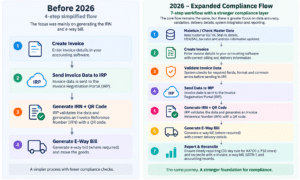
Let’s step back and understand the invoicing system and what has changed now.
Before the rule : Create Invoice, Check GST Details, Send to IRP, Generate IRN, QR code on Invoice, Generate E-way Bill and then move goods. This is the typical process, ending in 4 steps while creating a lot of flags with mismatch information.
For companies with multiple warehouses, branches, distributors, dealing with third-party logistics providers, can prevent the flagging issues or mismatch information with this new compliance. This new vigilant layer prevents these discrepancies.
After the rule : maintain master data GSTIN, HSN/SAC, TAC, Bill-to, Ship-to address, then create an invoice in accounting or ERP; the third step is to create and validate data in the software API, send to IRP, generate IRN and QR Code, and generate Eway Bill with corrected delivery details.
The 4-step process has gone to 7 steps, adding more compliance and data accuracy throughout, from the first step to the last one.
Note : Before, it was mainly about generating the IRN and e-way bill. Now the ship-to GSTIN needs to be captured throughout, wherever applicable. And this same data has to flow correctly in every order.
What Are the New E-Invoicing Validation Rules, and What Prerequisites Are Checked?
GSTIN/TIN new approach checks for:
- Ship-to GSTIN
- Ship-to State Code
- Ship-to PIN code
- Ship-to GSTIN are valid
- GSTIN matches its corresponding state code
- Bill-to GSTIN and Ship-to GSTIN are different entities
What was practised before as a habit of shortcuts, adding both Bill-to and Ship-to fields the same, now won’t be tolerated. These are red flags and have a high chance of getting rejected at the very begining only.
Beyond these red flags, there are other dicey activities that are brought under surveillance, and as a business owner, you should keep a check on this.
What Business Needs to Review in 2026?
Compliance isn’t a one-time task anymore; it’s an iterative process, with GSTN updating rules every year or two. That means employee training has to be iterative too.
A Tally course completed a few years ago taught the software as it worked then, not how GSTN validates data now. And training itself has evolved; it’s no longer just about entering data into sales vouchers; it’s about understanding the why behind fields like Ship-to GSTIN under the latest rules.
This is exactly why business owners and accountants need updated, specific Tally Course Online training, not a one-time, set-and-forget session.
Checklist to follow:
- Start with the data behind the invoice. Check if customer GSTINs, HSN/SAC codes, tax rates, billing address and delivery details are accurate. Remember, if the first step is wrong, the next step will lead to a bigger blunder.
- Check what happens when invoices are created. Does this information move automatically to IRP and where required? A transparent process is better, as it helps fix things quickly and identify errors at the initial stage.
- Beyond just generating invoices, address reconciliation too. Every input should have the same story, same information throughout. From sales staff, dispatch teams or warehouse coordinators, everyone should be trained on the new GST and have a strong understanding of what these fields mean and why it’s mandatory.
- Regulatory updates and compliance changes are part of the business cycle. Rather than rebuilding your processes every time the rules evolve, businesses should invest in systems that can adapt with minimal disruption. Over time, that adaptability becomes a business credit, not a compliance debit.
- For every product or service, check for HSN/SAC code, GST rate, taxable value, discount treatment, etc. With the new e-invoice system introduced, retail selling price-based commodities should align with their calculation instead of assumptions.
What Should Businesses Be Prepared for Further E-Invoicing Changes in 2026?
GST was designed to bring better transparency and a better way to trade and report transactions. E-invoicing is a further step to make invoice data more structured and connected. It is to gain better visibility and insights across the entire channel.
There will be new requirements, upgrades, updates, tighter reporting mandates, and more. As a business, investing in the right tools or software and having the right team on your side is the best investment you can make.
Stay updated with the official portal, keep an eye out for updates, regularly monitor updates, get compliance into everyday workflows and stay away from shortcuts. The penalties for dicey shortcuts are higher compared to the cost of staying compliant.
In a nutshell, be focused on building a stronger foundation that is flexible and adaptable.
FAQs
1. What has changed in e-invoicing and why is it important in 2026?
E-invoicing involves reporting eligible GST invoices to the Invoice Registration Portal and getting an Invoice Reference Number. It is essential for businesses to stay compliant, as the rule demands more connected accounting systems, e-way bills, returns and invoice data validation.
2. What happens if a business doesn’t comply with e-invoicing requirements?
Non-compliance can result in immediate rejection, e-way bill issues, reconciliation problems, delayed payments, disruptions and more. There is a high chance of hefty penalties.
3. Does e-invoicing affect business operations and financial teams?
Yes. The new e-invoicing isn’t just a step added to the process. It’s about every employee; every member should take care of these steps. From sales, accountants, logistics, IT and more, everyone needs to follow. Because the new process targets the whole cycle, from the initial basis to the end, everything should be in a single language, a single data set, accurately and precisely recorded.
4. Does this mean I have to train my entire team?
Yes. You have to train the team on the following rules and keep them updated, not detailed GST or accounting training. For the rest of the team, you can focus on awareness and habituating them to check every invoice before it goes in and out. Your finance teams need a more detailed understanding and to be more proactive in checking all data to meet the requirements and avoid penalties.